
13. April 2026 By Frank Lubatsch
Sovereign AI in sales – the catalyst for secure, scalable growth
As a sales leader, you’re under pressure: volatile prices, tight margins, shifting customer dynamics. That’s why many companies turn to ChatGPT and similar tools for emails, quotes, or analysis. The results can be impressive – but do you know where your data ends up?
Imagine your key account pricing, churn models, or margin logic being inferred from AI prompts – on thirdparty servers, outside your control. The goal isn’t to demonize AI – far from it. It’s to deploy it in a way that scales sales, protects margins, and reduces churn without losing control of your most valuable asset: your data. In this article, I’ll show why standard AI runs into functional limits and creates data risk – and how sovereign, enterpriseowned AI becomes a secure sales copilot.
Picture a simple diagram: your company on the left. From there, a pipeline runs into a large, anonymous “AI cloud.” Customer profiles, contract data, and price calculations drip out of this pipeline – unintentionally.
That’s what happens when your sales team uses standard AI systems with real data today. Every prompt, every copyandpaste from your CRM, every pricing calculation “quickly” checked by AI flows through this invisible pipeline into external thirdparty systems – into the wild, so to speak.
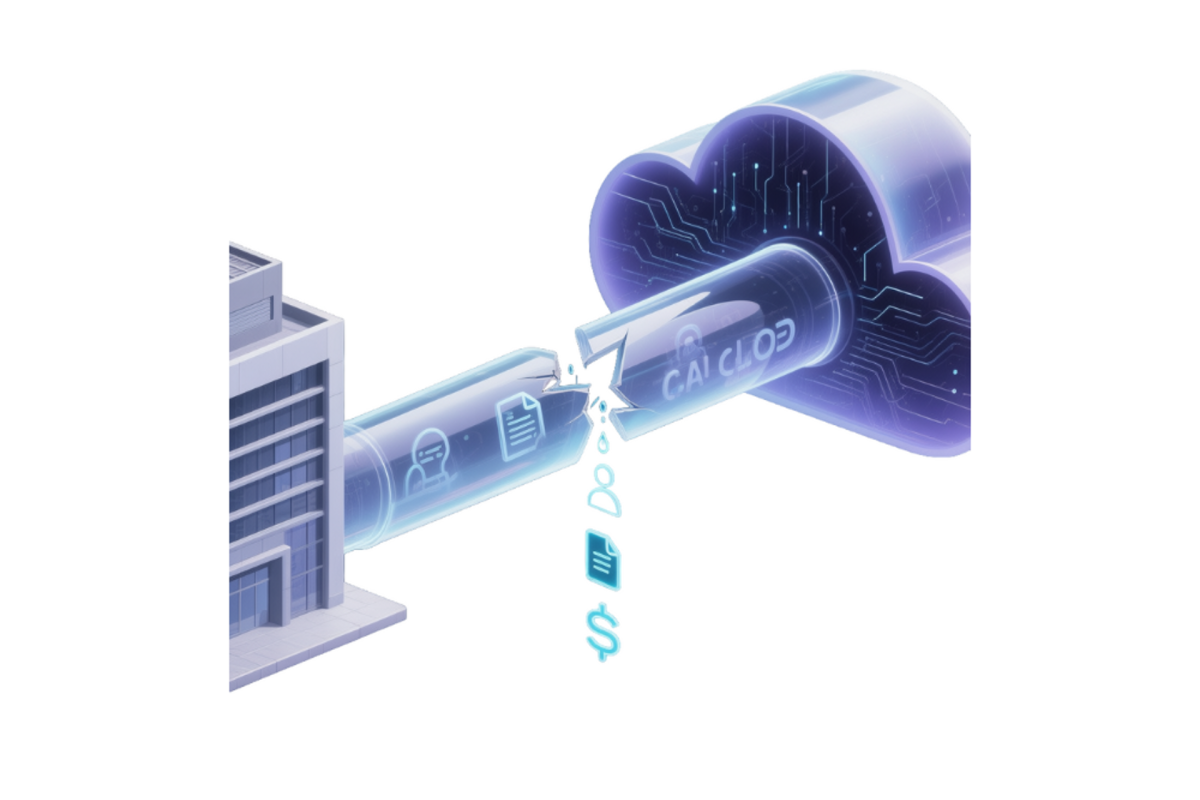
The insidious part: this leak is invisible. There’s no alert, no popup that warns: “Warning: you’re about to lose control of your data”. The moment sensitive information flows into a generic AI, the following is true:
- Your data sits on thirdparty servers
- You don’t know how long it will be stored
- You don’t know how it may be used in the future
For sales, these aren’t abstract risks – they’re concrete threats:
- Competitors can reconstruct your pricing logic and discount rules
- Customer segments, churn models, or crossselling strategies become part of someone else’s data pool
- Knowledge you’ve built over years leaves your organization
Your edge comes from market understanding, customer proximity, and deep, proprietary data. If that data leaks into external systems without control, your company loses its advantage, step by step.
The limits – why standard AI isn’t enough for sales
Generalpurpose models like ChatGPT are impressive allrounders. They draft copy, summarize content, spark ideas. But they aren’t sales specialists – and that becomes a problem the moment your team needs precise, correct support.
1. Lack of domain expertise
Your sales reality involves complex rate structures, timevariable pricing, network charges, levies, taxes, and regulatory constraints. A standard AI doesn’t know these details at the depth your company requires. Your specific rate plans, margins, discount logic, approval rules – all of that is foreign to a generic model. The result:
- Factually incorrect or imprecise answers
- Risky statements to customers
- Internal confusion when “the AI” contradicts your price sheet
2. No customer context
Standard AI doesn’t see the customer behind the question. It doesn’t know:
- Past complaints
- Payment behavior
- Purchase history
Without access to your customer history, every answer stays generic. To a standard AI, every customer is a stranger – and that’s how the suggestions sound: interchangeable, impersonal, and potentially wrong.
An example from energy sales: You ask a generic AI, “which rate plan would you recommend for Meier GmbH, customer no. 2323 with 50,000 kWh, load profile XY, and a PV system?” At best, you’ll get generic guidance – standard recommendations and general notes on selfconsumption, feedin, heat pumps, and so on. What you won’t get: your most profitable rate plan, tailored to your current procurement situation, within your sales strategy and risk policy. The AI simply doesn’t know your internal margin targets – and it shouldn’t, as long as it runs outside your control.
3. Security risk by design
Perhaps the most critical point: every interaction with a standard AI runs on external servers. That’s not a switch you can flip – it’s part of AI vendors’ operating model. With each interaction, you surrender a bit of control. Bottom line: standard AI can inspire, but it can’t reliably support sales – certainly not without jeopardizing your data sovereignty.
The solution – your own sovereign AI as a fortress for your data
The alternative isn’t “no AI,” it’s sovereign AI.
Your AI is designed to serve your sales – not the data appetite of third parties.
What does that mean in practice?

1. Your data – focused on sales outcomes
Your sovereign AI is fed exclusively with data that matters for your sales:
- Customer data (CRM)
- Rate structures and pricing logic
- Target groups, segments, churn models
- Products, bundles, crosssell strategies
- Processes, phrasing, and internal playbooks
No data garbage, no unnecessary bloat. The AI understands your business, your language, your rules. It doesn’t respond “generically well,” it responds specifically for your products and services.
2. Your infrastructure – data stays with you
Your sovereign AI runs in your environment: on your servers or in your private cloud. That means:
- No leakage of sensitive data to third parties
- Full control over storage locations, access, retention, and deletion policies
- Maximum security and 100% GDPR compliance
You decide who sees what. You define which systems to connect and which to keep airgapped.
3. Your control – the AI as a strategic asset
You own the AI. It is:
- Your tool in sales
- Your competitive lever
- Your intellectual property
You set the rules:
- Which responses are allowed – and which are not
- How to engage each customer segment
- Which sales goals to prioritize (margin, volume, retention, crosssell)
This turns AI from a risk into a strategic shield: you unlock efficiency and revenue potential – without sacrificing sovereignty.
The sales copilot – what’s in it for you?
Imagine every employee had a personal sales copilot – always available, always current, fully tuned to your company. Your organization benefits from:
1. Greater efficiency – less routine work
- Emails about rate changes, price adjustments, or contract renewals are autodrafted – in your tone, following your guidelines.
- Standard inquiries like “what’s my installment?” or “which rate plan is right for me?” are answered instantly by the copilot, clearly documented and traceable.
Your team saves several hours per week – time they can reinvest in relationships, complex negotiations, and strategic accounts. The sales copilot moves hard, measurable KPIs – not “nice to have.” Example (industrial machinery): roughly 30-40% reduction in timetoquote.

The sales copilot knows:
- Current rate plans
- Margins
- Active campaigns
- Customer histories
It suggests the right offer in real time – including logical addons (energy examples):
- Home EV charger with an emobility rate plan
- Heatpump rate plan when replacing a heating system
- PV + storage for commercial customers with high daytime usage
With the sales copilot, every conversation becomes a revenue opportunity – without requiring employees to memorize every combination rule. Less churn – proactive moves instead of firefighting. The sovereign sales copilot flags customers at high risk of cancellation before the notice hits your inbox. It shows:
- Who is at risk
- Why (price, service, competitor offers, usage patterns)
- Which counteroffers are likely to work
Your sales team can respond in a targeted way – personally, appropriately, and on time. This reduces churn and protects base margins.
2. Faster onboarding – knowledge on demand
New hires need months to learn all rate plans, processes, and edge cases. A sovereign sales copilot shortens that ramp dramatically:
- All internal rules, products, and playbooks are accessible via the AI
- Questions like “how do I handle this complaint?” or “what special conditions apply in the energy sector?” are answered in seconds
Instead of marathon trainings and lengthy manuals, your employees get inthemoment support – right during customer conversations.
From vision to reality: our implementation plan
Your secure, fast path to AI in sales – with measurable value.
1. Strategy workshop – focus on the biggest lever
In one day, we sharpen your sales vision together: We analyze your sales processes and systems (e.g., CRM, ERP) and identify the use case with the greatest revenue and efficiency impact – such as quoting, lead qualification, or upselling.
2. Data foundation – secure, clean, ready
In two weeks, we build the groundwork your sales copilot needs to deliver value: we set up a sovereign AI environment, prepare your data with quality assurance, and ensure compliance and security requirements are met.
3. Pilot project – your your copilot in the real world
Within 4-6 weeks, we develop a tailored sales copilot for your top use case: your team works with the copilot, tests real scenarios, and provides feedback. We then refine – technically and functionally.
Anchor digital sovereignty strategically
Maintain control over your infrastructure, data, and processes without jeopardizing operations. We’ll show you how to build sovereign architectures – from strategy through operations.
Conclusion
Sovereign AI in sales means harnessing AI’s strengths while keeping full control over your data and rules. The result: a legally robust data foundation and a sales copilot that measurably saves time, raises process quality, and lightens your team’s workload. Schedule a conversation with me to align on goals and guardrails. We’ll show you how sovereign AI can measurably advance your sales.
More about the topic


Category: |
|
Tags: |
Artificial Intelligence (AI) Digital sovereignty Security |
